Saturday, August 17, 2013

The summer "to do" list......

It was early June, Spring had finally sprung and the sheep were getting a bit hot so we decided to have a go at sheep-shearing ourselves.  The cost of some electric shearers was similar to one year's visit from a professional sheep shearer so we thought we would save some money and release our inner stylist!  The clippers duly arrived so we were armed and dangerous and off we set.  

At first it was tough going - the first sheep (the Ram who is twitchy at the best of times and also huge) took around 30minutes but it got easier.  In this photo you can see the bottle of iodine in Bee's hand ready to treat any cuts - of which there were a fair few - on the first few sheep. Last year, the professional shearer nicked the sheep plenty of times so we didn't feel too bad about it.


The sheep have ticklish hind quarters so they squirmed a lot and it was nerve racking being so close to the carotid artery!


It was back-breaking work and we only had 7 adult sheep to shear (the lambs were left un-sheared). Our hands were lovely and moisturised with all the lanolin. We used the wool to mulch around the fruit trees and asparagus bed as it wasn't quite spinning grade especially as the fleeces were a little incomplete because of our poor technique.
 
 
The sheep also got a pedicure as their hooves had grown considerably with the wet weather. We couldn't post a photo of the shorn sheep; they begged us not to as their street-cred was at stake, but imagine a sponge having a fight with a razor blade and you can visualise the outcome. We look forward to honing our shearing skills next summer.
 
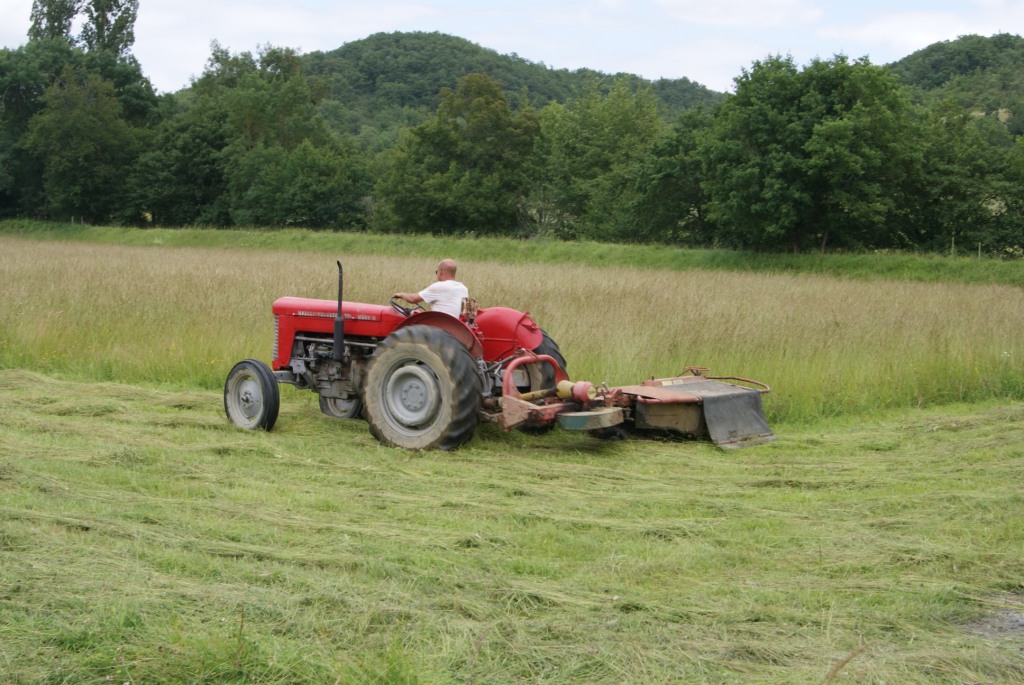
Another first this summer was making hay. The last two years a neighbour came to cut and bale it but we saw an opportunity to make and sell small bales for people who weren't equipped to handle large commercial round bales. Al had spent the spring collecting rusty old machinery and resurrecting it for a total cost of around €300 for the 4 tools needed (mower, hay bob, windrower and baler). At the start of June we had a week of good weather forecast so we decided to have a go at the first hectare (out of 4 in total) to test out all the equipment.  All worked fine except the tractor had a clutch problem so after the first hectare and before the weather improved again Al changed the clutch on the tractor. 
 
It was cut;
 
 
spun several times over the course of a few days;
 
 
then racked into windrows ready for the baler;
 
 
We borrowed the baler in exchange for getting it working again.  We learned lots about the workings of a baler and we can regulate the length and density and thus weight of the bales to allow one person to lift them. They weighed 19-23kg. It was a great workout loading them onto a trailer and hoisting them up into the barn hay loft! We made 450 bales, most of which we sold. The rest will feed our sheep and donkeys over the winter.
 
A huge thank you to the Dutch and St Gervais guests who arrived just in time for the hard graft !
 
We were thirsty after making all that hay so we combed the river and canal banks for elderflowers and made several batches of elderflower cordial and champagne. There is no photographic evidence of the champagne as it was consumed so rapidly!


We also road-tested the solar oven we had made in the spring. It took 2 hours to bake a loaf of bread but it is very useful to sterilise the preserving jars. It didn't go above 150 deg C but will certainly save heating up the nice cool kitchen when it's 35 deg C outside!
 .
 
 
Last but not least we managed to get the glass panels into the mill room floor. They had been glaring at us for seven months since delivery, waiting to be installed. It seemed slightly galling chopping holes into the floor we had constructed in December. We hadn't tiled the floor section for the panels as we intended to tile around the glass panels once they were fitted.
 
 
There is a 3 metre drop to the old mill wheel and water below.


We painted the new timbers of the new floor black for effect.


Phew, the panels fit and we can stand on them.....


They're in and we have now tiled around them.  We can also admire them at night with the halogen lamp we installed.  Now we just need to finish tiling the rest of the ground floor and clean up the mud and silt from around the workings so there is something other than mud to admire...........

Sunday, June 2, 2013

Wellies and winter clothes - in May

Morning of 31st May

Bee (draws back curtains);
"er Al think you had better see the canal"

Al (thinking);
Not getting out of bed as Bee usually exaggerates.

Bee;
"AL GET OUT OF BED AND LOOK AT THE CANAL!"

Al (looks out of the window);
"ok I'm awake"


We had been greeted by the sight of the accumulation of days of rain nudging towards to top of the canal walls and backing up from the river to the back of the mill.  Flood alert. Slightly more calmly than in January the sluice gates were opened wide (the one at the house had been repaired since the flooding in Jan - phew). Vehicles and borrowed items were moved to the highest ground and electric fencing turned off. Below you can just make out the top of the gateposts on the bridge - under a metre of water and impassable.


The water rose to within 20cm of the driveway from where the photo below was taken,


 The sheep/donkey field flooded....


 ... so they were all herded into the garden (farewell kiwis and all other shrubbery). It occurred to us the life-ring would probably fit around the donkeys' necks if necessary!


The sheep shared the garden nicely with the kids although seemed rather bemused by the trampoline but fortunately didn't try to eat it (or have a bounce).


The garden shrank in size as the lake beyond burst its banks and crept up the garden towards the house. The lake normally starts a metre beyond the fence behind the swings and slide.


The ducklings however were very happy with the rising water all around them, albeit confined to the paddling pool as their wings have been clipped so they couldn't fly out of the enclosure to a watery paradise.


Rosie the sow was due to be collected from her minibreak with the boar but her pen was under 50cm of water so she has been granted an extension to her holiday.


The veg patch field and polytunnel were under at least 50cm of water from the ditches flooded by neighbouring valleys - we could only see the field beans and wheat - everything else was under water.


The wild ducks were blissfully swimming across the fruit patch. The poor strawberries!


The solar panels had seen so little sun in May it didn't seem to matter their feet got wet.


In the afternoon, when all equipment and animals were safe, we had a reflective moment over a game of Swingball but were rather embarrassed when the fire brigade arrived mid-game to see if we were ok! They wanted to check we had opened all the sluice gates and to warn us the levels would rise again if the dam upstream had to release more floodwater.

It's now Sunday evening and the water has subsided although the sluice gates are still open as the river levels remain high. At least the garden has been fertilised by the sheep and donkeys (that was a mammoth pooper-scooping session) and the lawn won't need mowing for a while. The kids got a day off school last Friday as the roads were flooded so no complaints there. We will just have to wait until tomorrow to conduct a damage assessment of the veg patch to see what has survived the flood.


Sammy and Lucy haltered-up in case evacuation is required! Donkeys don't do wet hooves...

Monday, May 6, 2013

Floods, bacon and Easter chicks

Having just looked back at the last post we realised how much has happened since lambing at the start of the year!

A fortnight after the lambs were all born this area saw the worst flooding in years. We awoke to discover the canal water was almost brimming over at the front of the house and the bridge accessing the sheep/donkey field at the back under 1 metre of water from river water backing up to the mill. The pig pen was a swamp and the river was rising steadily against the dyke. Um, right. Initiate action-plan. Except no action-plan existed. The kids and cats were hustled upstairs with pain au chocolats and a film to watch. The sluice gates were cranked fully open . All electric fences were turned off (the chickens could fly to higher ground if necessary). Then the troops arrived - neighbours with trailers and tractors helped bundle the sheep and new born lambs and transported them to a hastily-made barn enclosure (on a hilltop!) and the black piglets were taken to another high-altitude neighbour with an old unused pigsty.

Rosie the sow refused to abandon ship so she was made a raised platform in the shelter and she wallowed around quite happily in her bog. A few sheep and the donkeys also refused refugee status and kept to the high banks of the field. Cooper the border collie seemed a bit bewildered by the disappearance of half the herd.

The veg patch was a sorry sight - the ditches bordering the field overflowed and the leftover drip-irrigation pipes floated across the field towards the pig pen. Fortunately we had only onions, leeks and brassicas in the ground which mostly survived their dunking. The polytunnel looked like an outdoor pool cover...

We realise now we didn't take a single photo during the flooding as we spent our whole waking day watching over the animals and raising materials to higher ground. It would have also been quite tricky holding a camera with fingers crossed hoping the water level wouldn't rise any more!

We had one more night of fearing the mill would flood (and had to wake hourly to check the level) but after 5 weeks of very very wet weather and water-logged land all the sheep returned home and we could finally start drying the place out. We danced a little jig the 1st day we could venture outside in trainers rather than wellies!

The 2 black piglets refuging in our neighbours pigsty, who had reached slaughter-weight, were "transformed" into hams, bacon, joints, sausages and pate under the watchful eye of our neighbour and a couple of friends who came to help out. The piglets had run amok during their stay with us and definitely had some wild boar genes within. We had managed to tame them to a degree but their penchant for chewing wellies (whilst attached to human feet) had gone beyond amusement as well as their constant escape attempts. We learnt (another) valuable lesson - don't keep pigs separated from their mothers too early - they don't respect electric fencing nor the hand that feeds them!

Whilst considering a worming programme for the sheep and donkeys in February a very simple and obvious treatment occurred to us (after a suggestion from a neighbour of course) - let the chickens sort it out. The 8 hens and cockerel (who had been swapped to avoid cross-breeding) were in a coop with a large run. We built a portable ark and placed it beyond the fence at the bottom of the garden. The principle criteria for this new ark was that we could lift between the 2 of us so it could be moved from field to field following the sheep and donkeys. At each stage of construction we had to try and lift it. Grunting and knee bending became more marked as the ark took shape but we got there! After a couple of days the hens were laying in the ark (or in the donkey shelter if a queue formed in the nesting area!)


The chickens now dutifully follow the sheep and donkeys around their field all day enjoying the parasites "deposited" for them. Nice thought. They now require less grain too so they are now completely free-range and organic (as the grain comes from an organic neighbour). Happy hens, happy sheep and donkeys and happy us. Job done.

Liberating the coop and run got us thinking about chickens for meat. Our hens don't seem to get broody very often so we have very few chicks born each year. We decided to give nature a hand so borrowed an incubator and heat lamp from a friend and chose likely candidates from the egg collection basket..... After diligently turning the eggs regularly and monitoring the temperature and humidity we were rewarded after 21 days with 5 chicks. In the photo below the first chick has hatched. The "S" on the eggs is for turning the egg in the "soir" - the other side of the egg had "M" for "matin" so we knew when the eggs had last been turned. Turning the eggs during incubation mimics a broody hen's behaviour of turning the eggs in her nest to keep them humid and prevent the yolk from sticking to the inside wall of the shell.


The chicks went under the heat lamp in the boiler room for a few more days then were relocated to the old pigsty till a few weeks old. They are very fluffy for a couple of days then start sprouting their adult feathers and look a little scraggy. They are completely tame as have had no mother to show them what to fear. As a result they happily sit in our hands and peck at Bee's sparkly engagement ring or perch on the kids' arms. On the flip side they are easy prey for buzzards, rats and weasels but they have been now let into the run so fingers crossed. The chicks at a few days old:

 
This chick was born 48 hours after the others and was pecked and bullied so was isolated for a while - please note clean fingernails  - doesn't happen all that often these days!


We may let this little bunch of fluffy chicks join our egg-layers or we may put them in the freezer at 4 months. TBC.

We gave nature another hand last week when we got bored of seeing the resident ducks abandon their ducklings all over the place. We have been netting lone ducklings forlornly paddling up and down the canal whilst their mums have been waddling around blissfully ignorant they are a few ducklings short. We even found one in the polytunnel cowering in the coriander. In this photo the ducklings are under 1 week old and under the heat lamp in the boiler room.


We hurriedly cleaned out another stall in the pigsty to house the ducklings (in keeping with unearthing past treasures we gained a sun-lounger, silver pocket watch, serving dish, knitting needles, sunglasses and as always; a pair of old slippers). We now have 9 ducklings from 4 different mothers in our care.  Magret de canard? Perhaps not but they must be slaughtered at 10 weeks old if they are to go in the freezer as apparently they are a right pain in the pitchfork to pluck after this age!

Although they are the greediest, messiest eaters we have ever seen (barring our children at the weaning stage) just seeing the ducks enjoying the lake and canal (and stealing our supply of chicken grain) is a great pleasure so we will decide their fate in a few weeks - if we can clip their wings before they fly away....in the meantime they are currently sharing their run with the chicks and loving their swimming pool courtesy of a friend happy to see a disused paddling pool go to a good home.


Winter is also time of tree-felling to collect enough firewood for the next season. A couple of huge poplars, some acacias way too close to the house and various other ash and willows were chain-sawed and pulled over using the tractor.... and we now have enough wood for next winter - we hope - all stacked neatly at the end of the barn to dry out. The aim was to cut down all the enormous trees over the next few years so we can then just cut down more manageable ones after that. We were offered the use of neighbourly muscle (yet again) and a hydraulic wood splitter this year which made swift work of the 50cm tree trunks - and probably saved a couple of weeks hard labour. The poplar (photo below taken last July) was a beast that towered over our scarecrow - and the electricity cables beyond - so was felled this spring.


It and other trees are destined for the fabrication of the planned donkey/sheep shelter that is to be constructed  - on higher ground to foil future flooding - and larger to accommodate our growing flock of sheep.  We have already divided the grazing into 3 fenced fields  - the sheep and donkeys will be rotated to ensure they don't get too much fresh pasture at any one time and allow the grass to grow enough to cut hay for the winter. We have admitted defeat with electric fencing for the sheep as they have neither respect nor fear for it. Fence posts were sunk with a manual post-rammer and sheep fencing stretched across it using the tractor to add tension. A lesson was learnt last summer trying to use the post-rammer in "concrete" clay earth so at the least the sodden ground worked in our favour for once even if we were post-ramming in snow-showers one day and hot spring weather the next.

We currently have a resting pig enclosure - Rosie the soppy sow has gone to find "true love" (as we told the kids) ie she has returned to her former owner to mate with a boar. She was always earmarked as a breeder and now the black piglets are bacon it seemed the perfect time for her to have piglets in peace. Gestation is 3 months, 3 weeks and 3 days so excepting Bank Holidays (they respect them as days of rest?!) she will return to us in a month and be expecting sometime in August. We can't imagine her any bigger than she already is - she weighs in at approx 180kg and her kisses are somewhat heavy handed on the kneecap but we are missing her and the pig bucket enormously.

It is now 4 months since starting this post  - from January flooding to May planting is a huge expanse in seasons. We have just today finished the main spring planting; potatoes, onions/leeks/garlic, tomatoes, butternuts, peas, beans, brassicas, fodder beet & peas, sunflowers and a swathe of other random root and legumes. We have planted a bit of everything to see what germinates a this time last year we hadn't got the polytunnel erected so hopefully this year we are slightly ahead even if the temperatures have been lower and the rainfall greater than in 2012. We are awaiting the wheat and field bean harvest and will soon start cutting hay from the grass fields. This year we are attempting to cut and bale it ourselves - cue Al to acquire lots of random and rusty farm machinery, add huge quantities of grease, buy a few new bolts and pray for long periods of dry weather.

 
And here is our new arrival:
 

Only joking but it got us thinking for the future.......


The mill room renovation

Oops just realised that we never published this post - it has sat quietly in drafts since January!!!! Well here it is now....

Wow, don't fall over but this is another blog post within a week.  I guess it is the dreadful weather we are having that has driven us indoors so we are catching up on jobs.

In the Autumn, we started work on the mill room; we were in desperate need of a second living space as the kitchen was starting to feel small what with the dining table, dresser and a sofa in there and no other rooms except bedrooms.  We have another room to develop - the room we call the threshing room (in reality it is a winnowing room) which lies beyond the mill room and together they formed the "industrial" part of the building as oppose to the living accommodation.

These are the before photos albeit with the electrical conduits in place and new windows;


During Winter 2011/12 we had already replaced the suspended floor in the mill room; this is the floor that spans the mill wheel area under the mill where the drive is created to turn the enormous mill stones.  The previous floor was constructed from seriously heavy oak beams laid flat onto two veritable tree trunks set into the stone walls. Unfortunately they were in part rotten with gaping holes and no insulation from the flowing water below. Once they were removed we added further treated pine beams set into the walls and linked them together with cross beams to create a solid grid of beams.  Onto this, we laid boarding with insulation and a vapour barrier.  The other prep work was knocking down a wall that had previous housed part of the bathroom that we renovated in spring 2012.

The work was mainly the plastering of the walls, decorating, cleaning up and treating the ceiling, cleaning up of the mill stones and their support structure and the tiling of the floor with reclaimed terracotta tiles (these also needed cleaning).

The walls were the big job so we started rebuilding the window and door frame corners and covering the previous rough plaster (made out of mud and straw stamped together) with a lime mortar.  These photos are after most of the lime mortar had been applied (note the laser level for the new floor - the only straight line in the room!!!)


Before the plaster could be finished we needed to clean up the mill stones as we knew this would create masses of dust.  The clean up of the mill stones was tough - they are simply not designed to be a feature in a clean living room and they didn't give up the grime and plaster without a struggle.  Several dessicated rat and mouse corpses, countless wheelbarrow loads of old cereal detritus and centuries of dust and spider webs and the result was pretty satisfying.  Hey its about the journey man!  We discovered that the stones are made up of 4 pieces of flint held together with metal bands and plaster  - it solved the mystery of how the millstones had got into the millroom - in 4 pieces instead of the unmanageable stone in its entirety. We also uncovered some beautiful wooded axles inside the mill stones;

The painting was done in 4 coats of a very watery mix of white lime, water and wallpaper paste (to set it better) and it went on quite easily. We used a special varnish called a patine on the metalwork of the mill stones;

The ceiling and wooden structure that supports the mill stones was treated with insecticide and then two coats of linseed oil;

As we completed the decoration ahead of schedule, we decided to clean up our stock of reclaimed terracotta tiles and lay them on the former wooden part of the floor and on the concrete of the old bathroom floor area.

The clean up job on the tiles was a dog - it meant soaking them in 5%  hydrochloric acid for 24 hours then laying them all out on a tarp and power spraying them to clean the worst of the dirt off.  The dirt was old lime mortar, red paint and general filth.  Then came the sorting them into 3 sizes to try to lay the same size on each row.

We glued the tiles on to the wooden and concrete flooring using double layered high performance tile glue.  This is a big no-no for purists as traditionally these tiles are laid onto sand using a weak lime mortar but that method won't work on wooden boards so we had to compromise.  Finally we will oil the tiles with warmed linseed oil to protect them from spills once the entire floor is complete.


We didn't expect to get all the floor tiled but we did the majority of it before Al's parents arrival for Christmas.  Ruth and Graham drove out from the UK so we shamelessly took advantage of them and ordered loads of kit including 3 laminated glass panels destined to be set into part of the rebuilt wooden floor.  We already installed a projector light down there so the panels will enable a view of the water wheel and a future potential hydro-electric generator (Al's pet project) underneath the floor.

This room has really changed our lives.  Overnight we had doubled the living space and finally we have a lounge that feels homely and spacious.  When it is finshed with the glass panels in the floor and the final few bits of carpentry completed, it will really make the place. We also fitted a temporary dividing door between the mill and threshing room for the winter. Here is the (almost) finished product;