Saturday, May 5, 2012

The little swines!

We have had pigs for about a month now and they seem to have hogged (!) so much of our time it is beyond a joke - whether they are escaping under the fence, squealing for food or attention - it has been a thoroughly testing time.  Having said that they are really quite lovely animals and their friendly nudges with their snouts are very affectionate although the circular nasal mud stains left on your trousers don't come off easily....

We went to pick up 3 weaners that were 2 months old (Gloucester old spot, large white and local black pig cross-breeds). They were hustled into a box in the boot of our car and put the car's aircon system to test all the way home - did you know pigs get car sick? Anyway....they happily went into their newly-made pig shelter within a half acre field which we had carefully fenced with 2 strands of electric fence at the recommended 20 and 50cms height off the ground. We kept them in their shelter for 24 hours again following the recommendations.  The following day we decided it was safe to release them and did so - within minutes they had braved the electric fence and sprinted off across the countryside.  Then followed our first (and hopefully last) livestock chase across open fields which was a cross between a Benny Hill and Whacky Races scene.

We rounded up reinforcements  - our wonderful neighbours downed tools and came to help (or perhaps simply to witness the English nutters attempting to outrun and rugby-tackle 15kg piglets). 9 hours later having chased them up and down the valley, into and out of woods, across fields, round hay bales, through ditches and vicious brambles we recaptured 2 of the 3 and despite many attempts to locate and drive out the third, he is still either running with the local wild boar (having a great time we suppose) or is no longer.  Lets call it a steep learning curve. We can laugh about that day now although we have flashbacks of having to stop running because of a stitch - although that could also have been due to trying to laugh and run simultaneously....

The piglets have now pretty much realised that we are their food supply and that it would be sensible to stick around.  They have continued to try and escape and we have had to condemn them to a kind of piggy Alcatraz for the moment with various perimeter fences, electric wiring, extra stakes and re-enforced corrugated iron sheet for walls.  If anyone tries to tell you a pig is stupid beg to differ as they are pretty damned conniving and persistent! At least they don't smell - something positive we have learned!
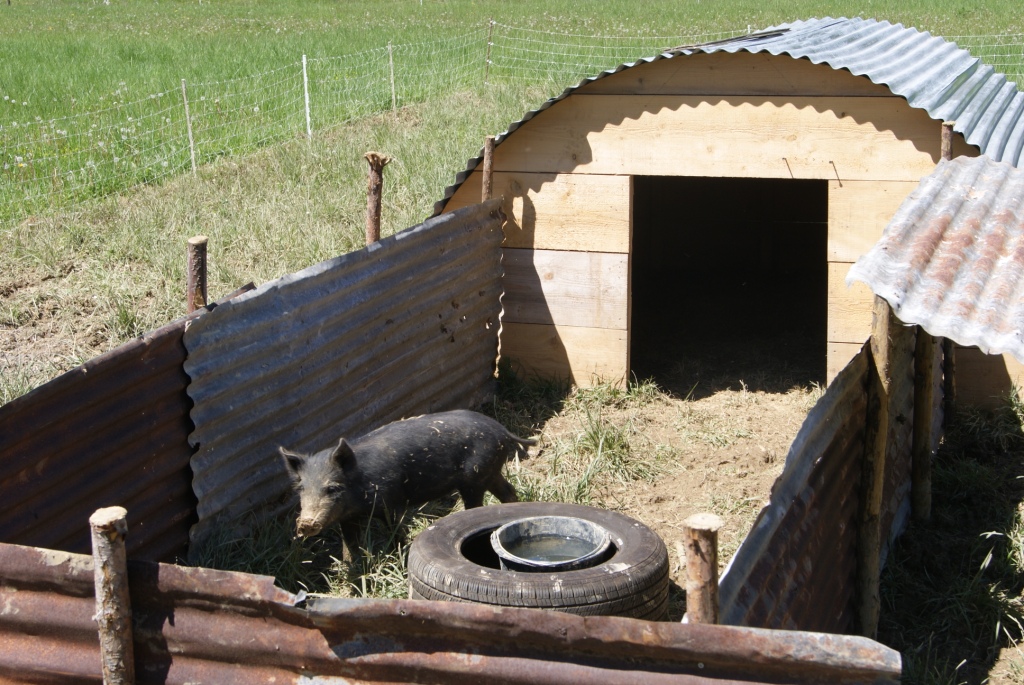

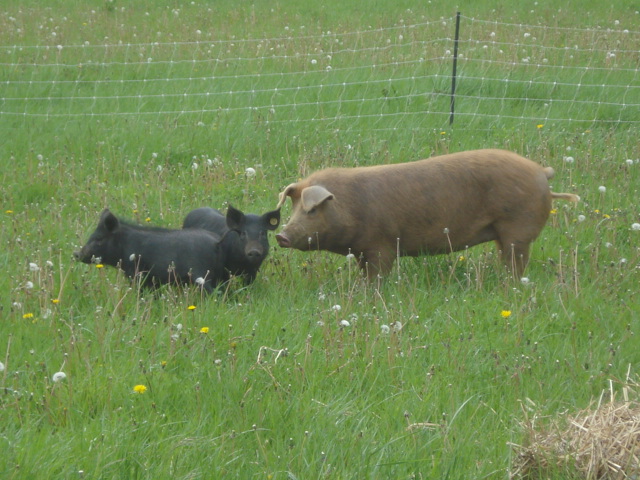
As we had lost one piglet, we decided to find another pig and we purchased a 5 month old (Tamworth and Gloucester Old Spot cross) female around 2 weeks back that we have named Rosie while names for the others have yet to stick.  The females (Rosy plus 1) are keepers for breeding so we are happy to name them but the sole male (without equipment) will be eaten next winter  

Other than the pigs taking up vast swathes of our time, we have been a little frustrated with the wet April weather.  Thankfully we sowed much of the veg plot before the wet weather but it seems only the spuds, peas and broad beans are really doing much yet but all in good time (we are told). We have yet to acquire the sacred virtue of patience. 

We should have constructed our poly tunnel during the dryer March weather but we have at least finally got the thing up and the tomato, lettuces and various other plants we had attempted to get to germinate seem to be enjoying the balmy temperatures. Hoeing, planting and watering in a sauna is a shirt off job (for Al at least - although Scarlett seems to think she can also enjoy this liberation from clothing as soon as Daddy strips off!).  We had our first storm today and it survived its first test - phew.

During the wet weather we did crack on with the downstairs bathroom and we are happy with the results so far considering the undulating walls and dodgy plumbing we discovered..  Another weeks work and the bathroom will be functional again but we are now prioritising the food production as we can see a few hungry gaps in the future if we don't.  Who needs a bath anyway?

Spring time at the mill is quite magical as a myriad of plants and trees take their turn to blossom, leaf and bear fruit of one kind or another; a spectacle we missed last year as we arrived in June.  The ducks have paired off and are sitting on eggs, the swallows are back from Africa and the trout in the lake are thriving on the mass of insects and tadpoles. 


Thursday, March 29, 2012

Whistle while you work!

Since we last posted, a years worth of weather has come and gone and as we write it is 25 degrees outside, bright sunshine but still cold enough overnight for a light frost to whiten the new grass and spring blossom on the peach trees.

February was a cold month - we had 3 inches of snow, temperatures as low as -18 Celsius and it lasted around 3 weeks.  We thought we had left all that behind in Chamonix but thankfully we were toasty warm in our house with the log-fired heating so it was only tough outside.  The mill leat froze to around 6 inches thick but no-one fancied skating except our resident ducks who seemed a little confused by their new ice rink.  The livestock seemed to be fine and we only had to feed them hay while the grass was covered in snow and break the ice on their water a couple of times a day.
 
During this cold snap, we started new renovation projects inside the house.  Firstly we replaced the entire structure for the mill room floor (while it was around -10C outside and almost that inside) as the old floor was solid oak 4 inch thick boards that were a bit rotten on the ends (they are now destined to eventually become a dining table).  We chiseled out slots in the stone walls and set new treated pine timbers onto concrete pads  and fitted cross members.  Because this floor hangs over the flowing mill stream (balancing on 3 inch wide timbers while 3 metres above a flowing stream was not in the job description!), we thoroughly insulated between the beams then placed a vapour barrier and agglomerate boards onto the beams to create a base to tile onto; when we eventually put down our reclaimed terra cotta floor;

Later in February we enjoyed a visit from Grandma and Grandpa (Graham and Ruth) who were a huge help with pruning fruit trees and burning gargantuan piles of branches (debris from firewood cutting) on 4 large bonfires that we kept burning almost all week.  The kids enjoyed a special campfire dinner of baked spuds in the embers with campfire songs led by Grandpa. Ging Gang Goolie etc...........


Granny (Els) came to visit shortly after and benefited from the higher temperatures (planting potatoes), the insatiable desire of the kids for their bedtime "Henrietta" stories and a Mother's Day trip round an agricultural fair looking at bulls the size of elephants and tractor parts that could bore the most geeky of tractor freaks (Al and Ben you know who you are).


March followed on with warm springtime temperatures of up to 20 degrees and we enjoyed bbq's outside with friends.  Strangely warm for early March but good for the heart and soul.  Later in March we had a period of rain when we came back inside to knock out the downstairs bathroom and start rebuilding it in a new format.  This was essential work to allow the conversion of the neighbouring mill room into our lounge.  Destruction felt good although Al hogged the sledge hammer. 


The warmer weather has brought everything back to life fairly rapidly and now at the end of March we have peach, cherry and apricot trees blossoming while the plums, various berries, rhubarb, soft fruits and apples are all budding nicely and of course the weeds are back on the old veg patch "en masse".

Despite itching to carry on with the interior renovation projects we have to concentrate on feeding ourselves for the rest of the year so we have started our spring sowing.  This involved turning our previously ploughed field (that had benefited from the heavy frosts to kill the turf) into something resembling a veg patch.  We started off by disc harrowing around 10 times in total - this chops up the clods, hopefully kills some of the young weeds that are already growing and breaks the ploughed land down to a fine tilth to favour the new seeds.  Disc harrowing comes a close second to ploughing on the tractor entertainment scale.

We then divided the plot into 4 rectangular beds (approx 15m x 45m) for four types of vegetables - potatoes and solinacae (tomatoes and the like), legumes (peas and beans etc), brassicas (cabbages and broccoli etc) and finally roots and onions.  These beds will be rotated every year to reduce the risk of disease build up and to aid fertility of the soil where needed.

We have now sown directly the following; seed potatoes (200 seeds with another 200 to plant in a few weeks), peas, broad beans, turnips, garlic, shallots, carrots, onions, parsnips, spring onions and red onion.  Inside we have tried to gain a head-start by sowing into pots (toilet roll inners to be precise) tomatoes, peppers, cabbages, melons, basil, sage, dill, various lettuce, sprouts and leeks for transplanting outside when they are established. The polytunnel isn't quite complete so all these pots are currently spread across the threshing room floor. Running the gauntlet across the rotten floorboards with a water sprayer is now part of our daily fitness regime!

As if cross-referencing all the gardening books wasn't complicated enough - when, how and where to plant everything etc - Al threw a spanner in the works and bought Bee a guide to planting according to the moon's cycle. We now have a loose system of planting when the locals plant, admiring the moon and using more loo roll than necessary to keep up with the loo roll inner demand for sowing.

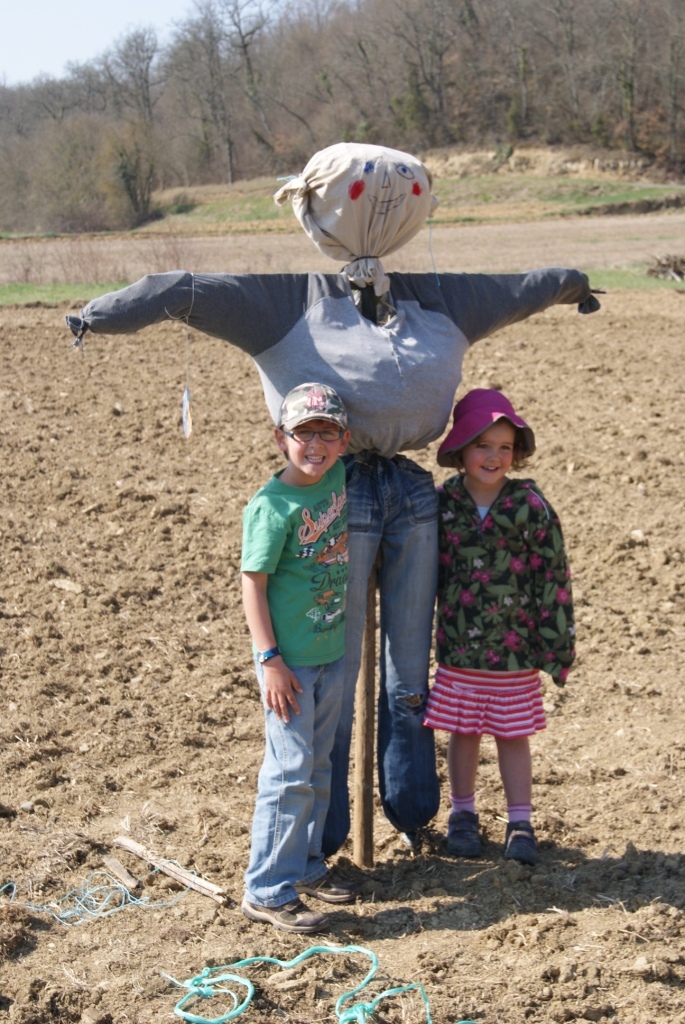
We have a new addition to the family - Johnny the Scarecrow. He's like a cross-dressing Worzel/Aunt Sally as the kids couldn't agree on the gender.....

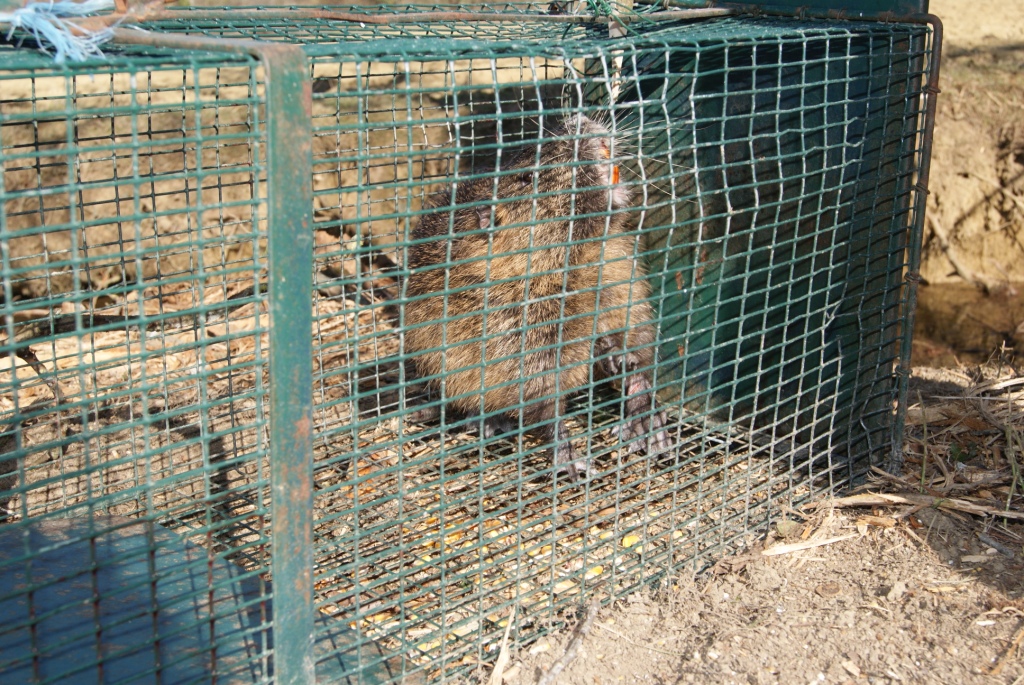
On the subject of pests, our local hunt offered their help to control the population of an animal called a ragondin which is a relative of the beaver. The locals fondly refer to them as wetland hares.  It is not native of this area and they dig large underground galleries which undermine river banks and eat masses of corn from the neighbouring fields.  They are also pretty dangerous to dogs and kids as they'll take fingers off in an instant with those long front teeth.

In a couple of weeks, the trappers caught 20 odd (one as large as 12kgs) and disposed of them for us.  All in exchange for a few jars of homemade pate (pork, not ragondin although we hear there is a restaurant nearby that turns them into pate and flogs it to Parisian delicatessens - urgh).


Talking of pate, while it was still quite cool in early March, we went off to a farm with our neighbours and selected a pig weighing a slight 140kg which we slaughtered on site. 2 beautiful hams are now curing as well as sides of bacon.  Joints and ribs stock the freezer, 24 jars of pate were made and we attempted to recreate Lincolnshire sausages.  The head, trotters and skin were all boiled up and made into another kind of pate - the kind that we generously gave away to neighbours and local hunters.  Hairy pigskin sprouting proud of jellied pate is not quite to our taste!  Although who knows we may be tucking into it next year along with everyone else - or maybe not.

Our "wild" livestock are enjoying the spring weather too - our trout in the lake are feasting on the tadpoles that are clinging to the banks for dear life. The resident ducks are pairing off (playing "touch-touche" according to the kids - tag in English!) although they have a hard life choosing whether to bathe in the lake or canal so flit between the two. The swallows are back to nest in the barn - they welcomed us here this time last year when we came to visit the mill with the kids. Lets hope they don't collide with the cockerel who still flies into the barn to roost at night.


Monday, January 30, 2012

Back, Sack and Crack

Last week we had a good look at the sheep's' hooves which were found to be in a terrible state and the dags were looking grim so Al got on the internet and ordered a pair of hand shears and nail-clippers.  There was no putting it off  when the tools arrived so this morning the sheep were corralled into the shelter (using maize as bait) and one by one they were tipped on their bums and they underwent a full pedicure and the sheep's equivalent of a Brazilian. We have never handled shears so carefully......

Here are the last 3 of the 8 looking nervous; they were hatching an unsuccessful escape plan at the time;


Here is one of the worst ewes' feet  with the nails completely curled under the hooves (this one had been a little lame at one point which prompted the exercise);


And here she is post pedicure;


She underwent a light pedicure to allow her hooves to get used to their new shape and will get another trim soon now we are a bit more practiced. Bizarrely the 2 rams were easier to handle than the ewes - think they may have been to a spa in the past as they seemed to enjoy being pampered.

We thought we wouldn't offend anyone's sensibilities with photos of dagging - we'll leave that to your imagination............and go wash our hands!

Tuesday, January 24, 2012

Trading in the spirit of self-sufficiency

If the ideal of no money changing hands be true, then our most recent trade came up trumps - the tired old Citroen AX that made it from Chamonix that has since been languishing under the car port was exchanged for 3 lambs. The trailer that brought them towed the AX away.   The little 4x4 runabout now has a new loving home but we are happy with our 2 ram lambs and one more ewe.


We are now up to 8 lambs and had our first experience of flipping them to find out if they are boys or girls and to check their hooves. They were corralled into the shelter (in truth they were bribed with maize) and we stopped and looked at each other asking how were going to actually catch them? Calling them and finger clicking certainly didn't work. Solution - Al tackled the nearest one from behind by grabbing its fleece and dragging it onto its bottom.  This technique seems to work well but it is best to grab them on their rumps as it hurts them less.   The lamb (all 20+ kg) surrendered to an inspection (how did Bee get that job?!) and was let back out into the field. The poor rams got marked with a blast of building-site spray paint  - not sure they are too pleased with their new orange-neck look. Now they all just need a good dagging (bottom trim) and pedicure and they will look beautiful!

The only real dilemma we face now is whether to leave one or both ram lambs with the ewes all the time.  With large sheep farms, the rams are kept seperate from the ewes and only introduced for a set period in order to reduce the spread of the lambing period and to time lambing with the best flush of spring grass whereas in SW France, we get strong grass growing in Spring and Autumn (and almost none in mid summer as it is too dry).  We would be pleased if the ram lambs do their business in the spring to time the lambing with the Autumn grass.  Once their work is done, the rams will be dispatched to the freezer.

Big learning curve but great fun!

Friday, January 20, 2012

White and fluffy


Well the sheep finally arrived a few weeks back and after some shocking behaviour (5000 volts electric fence to be precise) they settled in pretty well.  It took about 3 zaps per sheep for them to learn that the boundary is not to be crossed.  Having said that, their flocking instinct is so strong that one little chancer that pushed through the electric fence in a bid for freedom realised she was all alone and decided to push her way back through the live wires to be with her mates.  Honestly it is like women and going to the bathroom together! (Al wrote that bit....)


The lambs are crossbreeds but are majority Berichon du Cher which is a stocky meat animal from a region north of here.  They are all ewes and about 8 months old - they are "store" lambs which we discovered means they weren't fattened enough to be sold last Autumn. The donkeys are taking the new arrivals well and are guarding them from the local itinerant dogs (not that we have seen any) and foxes etc. We have sort of selected which two lambs we are likely to put in the freezer once they have been fattened up a little more (we point and whisper in case they understand!)  Al has got his eyes on their fleeces as sheepskin rugs would look great in our bedroom!

At the moment they are pretty happy with their pasture (we are strip grazing them over a large field) but we occasionally give them some maize and wheat to supplement their diet - this has to be done when the donkeys are out of the field being "walked". Bee usually gets the enviable job of walking the donkeys around the barn whilst the sheep are being fed - and hanging onto to the donkeys for dear life when they hear the grain bucket being rattled for the sheep......

Thursday, December 29, 2011

The wanderer returns......

Well today was a great day - Moke our 11 year old cat who disappeared in June when we first moved down here came home!

Well he doesn't win any awards for intelligence - Al spotted a cat in a field 1km from the mill on our way home - after squelching through the field we realised it was indeed Moke. 6 months on the run and he was only a few hundred metres from home all that time.

Apart from losing a few pounds (not a bad thing) he seems otherwise ok and has settled right back in.....we thought he was still hitching back to Chamonix! The mouse population had better take cover as we are now back upto 3 hunters patrolling the mill.....

Heating system

This is a post for the technophiles out there who may be slightly interested in the heating and hot water system we installed in the Moulin.  We suggest those who aren't into this to put the kettle on!

With the diminishing world supply of oil and gas controlled by distasteful companies and the prices climbing steadily into the stratosphere, we realised from the start that wood-fired heating with some solar input would be the way forward and once the capital investment was completed it would mean the only running cost would be our man-hours to cut logs.  This would be especially eco-friendly if the wood used was cut from the land around the property and luckily we have plenty of decent wood to burn so we started doing some more in- depth research into the subject.

Initially, we hoped to cook, wash and heat the house using a wood-fired cooking range with back boiler (for a radiator system) but we struggled to find any of these appliances that could get anywhere near the 25kW requirement to heat the house (this figure was established by our plumber Klaus by calculating all the heat loss from the various materials used in each room in the house) so we decided to put a wood-fired boiler in the barn which is very close to the house.

This also had three knock-on advantages in that the site of the proposed solar panels was around 10m closer to this position (meaning shorter tubes to connect them and hence a smaller and cheaper pump), secondly that the serious mess of 10 cubic metres of logs being burnt every winter would not come into our kitchen but stay in the barn and finally the dedicated boilers available are simply far more efficient than a hybrid machine that tries to achieve cooking/hot water heating/heating in one and such a machine would need to be burnt at 100% of its capacity to heat the house which would make the kitchen unbearably hot.

Having decided to go for a wood boiler (also known as biomass boiler) our plumber recommended a German company called Buderus (part of the BOSCH group) and in particular a new technology call wood gasification.  Effectively the wood is turned to gas at quite a high temperature as air is forced down onto the wood.  The flame is pushed down through a slot under the logs and the gasses burn again in a lower chamber reaching a temperature up to 1100 degrees C.  The boiler achieves 85% efficiency and very few cinders are produced (removal once a week is sufficient).  Here is a link to the sales docs in French (not available in English unfortunately) http://www.buderus.fr/files/200904271112190.Logano%20s121%20_%2066%20100%20100.02-08%20pdf.pdf

After researching the subject in depth, we learnt that in order to maximise the benefits of these boilers and to increase the ease of use, it is very useful to feed the heat produced into a massive water tank known as a heat store (we chose 1250L) which takes the massive amount of energy produced in the relatively quick burn period and stores it to be then used for the heating or hot water throughout the day.  Often the space heating and hot water in the house is required in the morning and evening whereas the boiler might only be lit once or twice a day.  Without a heat store, you have to keep the boiler burning slowly 24 hours a day which ruins the efficiency and quickly fills the chimney with soot and tar.  Heat stores are also fantastic for solar systems as they take heat in all day and make it available for your use in the evening or even 3 days later if you have a cloudy period.


The decision to add a large set of solar thermal panels (not to produce electricity just heat for the heat store) was influenced by three reasons - firstly in summer it is pretty disagreeable to have to light a wood boiler (it just gets super hot in the boiler room), the panels are large enough to contribute to winter heating by preheating the water in the tank and most importantly the French government gives grants to install solar systems (which includes the heat store tank which reduces the cost of that by 45%) which brings the total cost of the installations down by around 30% in total.  Rather than put them on the roof of the house which we found pretty ugly, we placed them on a concrete slab close to our car port.


The radiators circuit is supplied directly from the water in the tank itself in a closed loop.  This is pumped by a standard central heating pump controlled by a digital thermostat in the house (we were lucky enough to have spare cabling going from the fuse board to the boiler room during the rewire of the boiler room so these were used for the thermostat controller).

For the domestic hot water production we had the choice of two systems - firstly a tank in tank system where the hot water of the large heat store tank heats a second tank within the large tank or secondly a seperate heat exchanger outside the tank where when a tap is opened, a pump will take hot water from the heat store and run it past cold flowing water from the mains supply which instantaneously heats the cold supply and sends it into the hot taps in the house.  We chose the second solution because it is safer for potential legionella problems (large quantities of domestic hot water are not stored for long periods hence the push towards combi boilers that heat water instantaneously in the uk) and because the second solution does not hinder stratification of the water in the heat store.

Stratification is all about having very hot water at the top of the heat store (which is where you need it to supply the hot water or heating production) while the bottom of the tank might be cold or luke warm.  What you are trying to avoid is heating all the tank at the same time and waiting a long time while the whole 1250L goes from cold through luke warm to moderately warm water which will not really give you a good shower or warm the house up much.

This is the control panel on the instantaneous hot water exchange module;


And the position of the hot water module and central heating pump;


 All of the equipment except the wood burning boiler was supplied by Klaus the super efficient German plumber who we found on an internet forum and we are grateful for his exceptionally neat work, honest approach to delivering a top quality system and generally being a top man.  All the equipment was ordered from Germany and the quality is excellent.  Klaus prefers to order equipment that he knows he can fit with confidence that it won't fail and let the clients down.  Prior to the the current cold temperatures we are experiencing we thought we had over engineered the system but we now appreciate why Klaus suggested such a big boiler and a big heat store as we are enjoying living in a toasty warm house and with a system that is simple to use, efficient and eco-friendly.  

In terms of radiators, Klaus originally proposed some modern efficient radiators but this time, we decided that form would govern function and Al found that Acova the French company that makes towel rails also made their retro style radiators in central heating models so we increased the budget slightly and went for the lovely cast iron look. 

We are still in our first few months of using the new system (although we had the solar hot water working since mid September which was very efficient) and thus far it has proved very easy to use and the house is very warm.  Old stone houses like these are known for being draughty and cold but we have installed double glazing throughout the living rooms and kitchen and added thick curtains to all the single glazed bedrooms.  While we treated the roof beams in the loft, we also added 250mm of rock wool (essential for summer cooling as well as winter heat loss).  In the autumn, we used purely solar until quite late into the season and then went through a period of lighting once a day and burning one batch of logs and then letting it go out.  This was a bit painful as you go through tons of kindling and newspaper.  As the temperatures dropped and are now below zero at night (during the last 7 days) we are burning 24/7 and the boiler needs loading perhaps 3-4 times a day.  It is going through logs at a fair rate - we estimate approximately 10 cubic metres a winter which is a lot but we believe the trees on our land can cope with that production.  We hoped the solar would produce more heat in the winter but we intend to change the angle on the panels (currently set to maximise year round outputs) to maximise winter output and we hope this will improve further the contribution made by or solar system.

As we are refusing to purchase logs for this current winter, we are obliged to burn the log pile that the previous owner left behind which is of variable quality.  We are supplementing this with freshly cut Ash as this is the only tree that can be burnt green and luckily we have enough Ash to keep us going this winter.

We are gradually preparing wood stores for the next two winters and thinning out Alder copses we have growing on the wetter areas of the land.  Alder being part of the beech family should be a decent firewood once dried and handily, none of the trees are large enough to warrant splitting which saves man hours. We also have plenty of dead or sick wood to clear including a massive Poplar that needs felling before it drops on nearby power cables and plenty of Horse Chestnuts, Acacia, Cherry, and so on. A couple of hours work every few days soon cuts and stacks a lot of wood and luckily we have the tractor and trailer to move the wood back to the drying area on the end of the barn (under direct cover but open to the wind).

We would also like to thank Rob Gwillim at the Centre for Alternative Technologies in Wales who advised us on the planning of the system in a professional, knowledgeable and independent manner.